
A stream of consciousness By Haya Odeh, Co-founder & Head of Design, Replit May 2026
From the moment I got married, the question started.
When are you having children?
Then, once I had them: How are you still doing this? Why do you even need a job? Your husband is providing.
I heard versions of that my entire career. The assumption underneath it, that a woman's ambition has a natural stopping point, that motherhood is where the building ends, is something I've been quietly arguing against for over a decade. Let me try to form my thoughts around this in answers to questions I’ve heard from others or pondered myself. Questions that mothers out there can relate to.
What kept you going for ten years?
People ask me this like the answer is supposed to be a sacrifice story. Like the honest answer is: it was hard, I gave things up, I pushed through.
But that's not actually what happened.
I thrive intellectually. I need to build. Not to prove something, not to keep up with anyone because it's genuinely who I am. The idea that marriage, or motherhood, or the fact that my husband is a provider, should have changed that? It never made sense to me. I didn't stop needing my own work just because my life got fuller.
What kept me going for ten years is the same thing that started me: I love this. And motherhood didn't shrink that. It deepened it.
What did it look like when you got pregnant and you were building?
When I had my son, I was the only mother at Replit.
There was no one to call. We were so early that no policy had been formulated. I was figuring it out in real time while building, while pregnant, while navigating what it actually means to run a company and grow a family at the same time, without a map.
I went through the COVID period without caregivers. I held a lot of things at once that I didn't have help holding. But I want to say something about that, because I think it's important: that experience wasn't only hard. It was clarifying. Being the only mom meant I had direct sight into what families actually need at work. What's missing when it's not there, what it feels like when no one has thought about you. I used that. The maternity leave, the paternity leave, the caregiving support none of it came from a consultant’s deck or a benchmark. It came from having lived the gap and deciding to close it.
How does being a mother show up in how you lead?
People sometimes say Haya is the "mama of the company” like it's a cute thing, a soft thing.
It used to bother me. But, now I don't take it that way.
There's a version of professional life where women hide the mother in them, because they're worried it will make people take them less seriously. I understand that instinct. I've had it. But I stopped doing that. I am a mom. Embracing it freed me. It became, honestly, one of my clearest sources of power.
When I say someone is not a good fit for our culture, I'm asking people to trust a specific kind of judgment. The instinct that tells me when something is off, when someone will protect the people around them or won't, when a room feels safe or doesn’t. That's years of watching, caring, reading people accurately because the stakes were real. Motherhood sharpened that instinct in me. I'm not going to pretend otherwise.
What has it taught you?
I didn't appreciate my grandmother or my mother enough when I was growing up. I do now.
Becoming a mother changed how I understand where my own strength comes from. The grit I have, I know now, it's not original to me. It's inherited. It was passed down through women who held harder things than I've had to hold, who built what they could in the conditions they were given, who kept going without anyone asking what kept them going.
I think about my Middle Eastern lineage a lot. It makes me want to do something with it.
I have kids and I'm scared to take the leap and build. What should I do?
I get this question more than almost any other.
Here's what I want to say to the woman who asks it: the fear is real, but the premise is wrong. The question assumes that having children means you have more to lose. I think it means you have more to draw from.
You know things now that you didn't know before – about endurance, about prioritization, about what actually matters. You've managed more variables simultaneously than most people in any given boardroom. You've made decisions under pressure and exhaustion that would have stopped other people cold. You did not become less capable when you became a mother. You became more capable in ways that don't always get named.
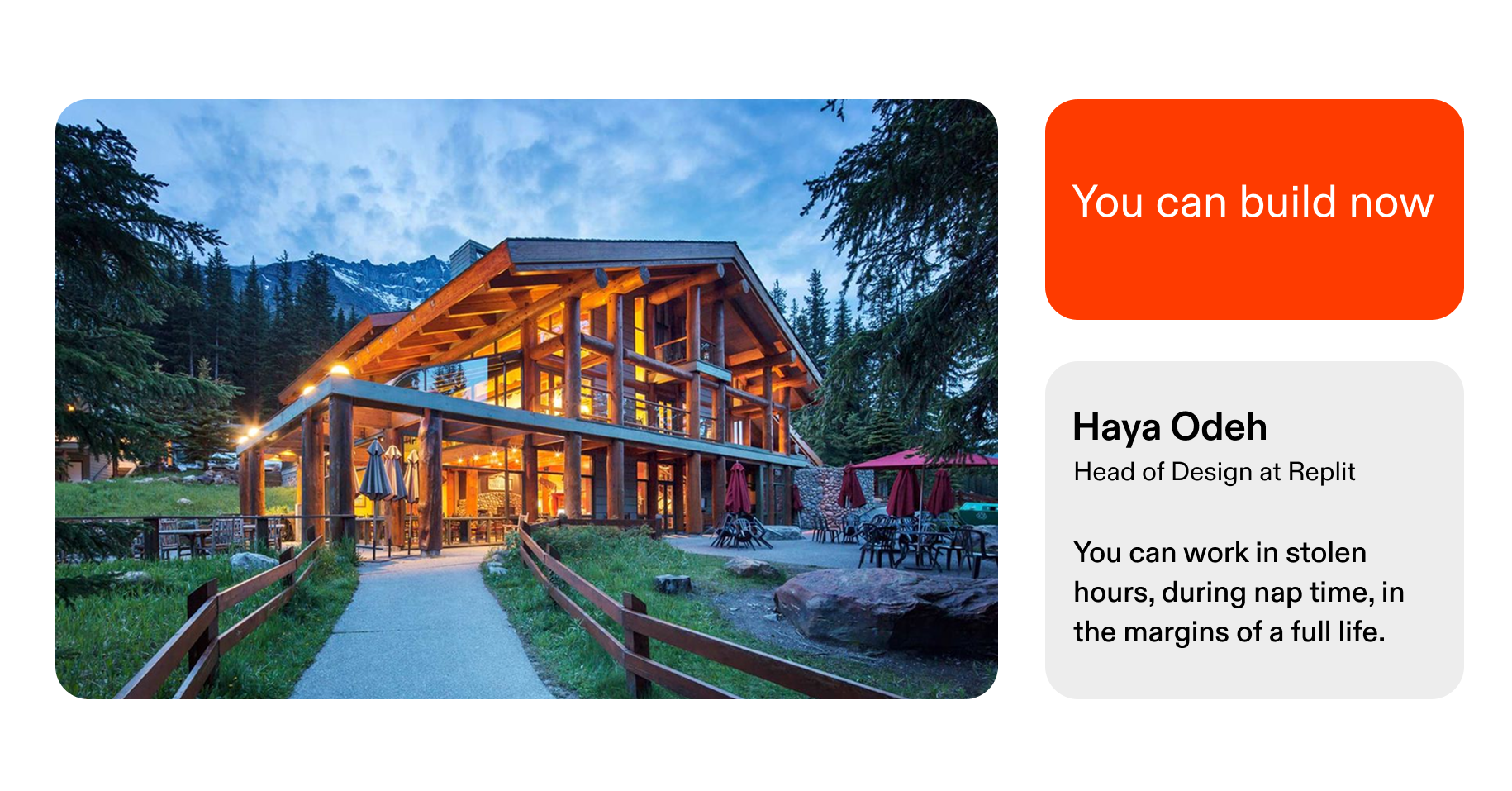
And practically: you can build now in ways that weren't possible even five years ago. You can describe what you want to build and have it come to life. You can work in stolen hours, during nap time, in the margins of a full life. You can ship something real without a CS degree, without a co-working space, without anyone's permission.
The leap looks different now. It's shorter than you think.
On stay-at-home mothers because I want to say this too
Some people think being a stay-at-home mom is not a job. That maternity leave is a vacation. That the work that happens inside a home, without a salary attached to it, is somehow less real.
That's wrong, and I want to address it directly. That is the job where you don't get paid for anything. It is full-time, unscheduled, unrecognized labor, and the women doing it are not on vacation. They are working one of the hardest and least acknowledged roles to exist. The fact that our economy doesn't compensate us for it, doesn't mean it doesn't count. It means we've chosen, as a society, not to look at it clearly. I have a lot of respect for mothers who build companies. I have just as much for mothers who build families and consider that the whole job. Both things are real work.
What I'm watching happen and where we should be
There's something shifting out there that I think doesn't get talked about enough.
Women are building quietly, then all at once and I want Replit to be the place that's ready for them before they even have to ask. Mothers who started a business during nap time and turned it into something real. Founders who never studied CS and don't need to anymore. Women in Lagos, Amman, Cairo, São Paulo, who have an idea and a phone and, because of what AI can do now, nothing stands between them and shipping it.
Rebecca built a legal app to navigate her own divorce, she needed something that didn't exist, so she made it exist. Kelly built a spelling app for her child; it's on the App Store, built in the margins. These are not exceptions. These are the norm, and we're just beginning to see them. The barrier to building has never been lower. The credential gap is shrinking, the geography gap is shrinking, and the time gap, which has always been the most punishing for anyone juggling care work, is shrinking too.
A few months ago, a story ran in Business Insider about Rachael Fuller, one of our product engineers. She signed her contract one week before she found out she was pregnant with her second daughter. She worked until midnight in her third trimester. She led a major product acquisition. She shipped until the day she gave birth. What struck me was why this was possible. She talked about her coworkers' kids coming into the office, and nobody making it an issue. She talked about parents bringing a kind of time management you don't develop any other way. She talked about 5 to 8 p.m. being sacred family time, held, honored, non-negotiable because that's just what we believe here.
That is what it looks like when policy comes from lived experience instead of theory. You don't build that by writing a memo. You build it by having been the only mom, and deciding things would be different for the person who came next.
Happy Mothers’ Day
If you're building something, a startup, a side project, an idea you haven't told anyone yet, I want to hear from you.
— Haya Odeh, Co-founder & Head of Design, Replit