Understanding Windsurf
Windsurf is the standalone AI-native IDE featuring Cascade, an agentic system that handles multi-file edits autonomously. It offers code completion, live previews and deployment integration.
The bigger change is the name. Cognition, the company behind the Devin agent, acquired Windsurf and rebranded it as Devin Desktop in 2026, and windsurf.com now resolves to devin.ai. Plans and settings carry over automatically.
Even so, plenty of developers are weighing a move. Some report occasional Cascade instability, and some simply want a tool that is not mid-rebrand. This guide walks through eight alternatives, verdict by verdict.
How we picked these tools
The list spans four ways to replace Windsurf. Agent-first IDEs swap the whole editor, extensions add AI to the one you already use, open-source agents give you end-to-end control, and cloud platforms build and deploy for you. One entry reviews the code the rest produce.
To make the cut, a tool had to be actively maintained, publicly priced and independent of Windsurf itself.
| Tool | Best for | Free plan | Paid plans from |
|---|---|---|---|
| Replit | Building and deploying full apps from prompts | Yes | $20/month |
| Cursor | Agent-first desktop IDE swap | Yes | $20/month |
| GitHub Copilot | AI inside the editors you already use | Yes | $10/month |
| Cline | Full control over models and spend | Yes | Pay per model use |
| Aider | Terminal pair programming with Git | Yes | Pay per model use |
| Zed | Raw editor speed with optional AI | Yes | $10/month |
| Qodo | Agentic code review and quality gates | No | $30/month |
| Bolt.new | Rapid in-browser prototyping | Yes | $25/month |
Product and pricing information: vendor product and pricing pages, August 2026.
Top Windsurf alternatives compared
1. Replit
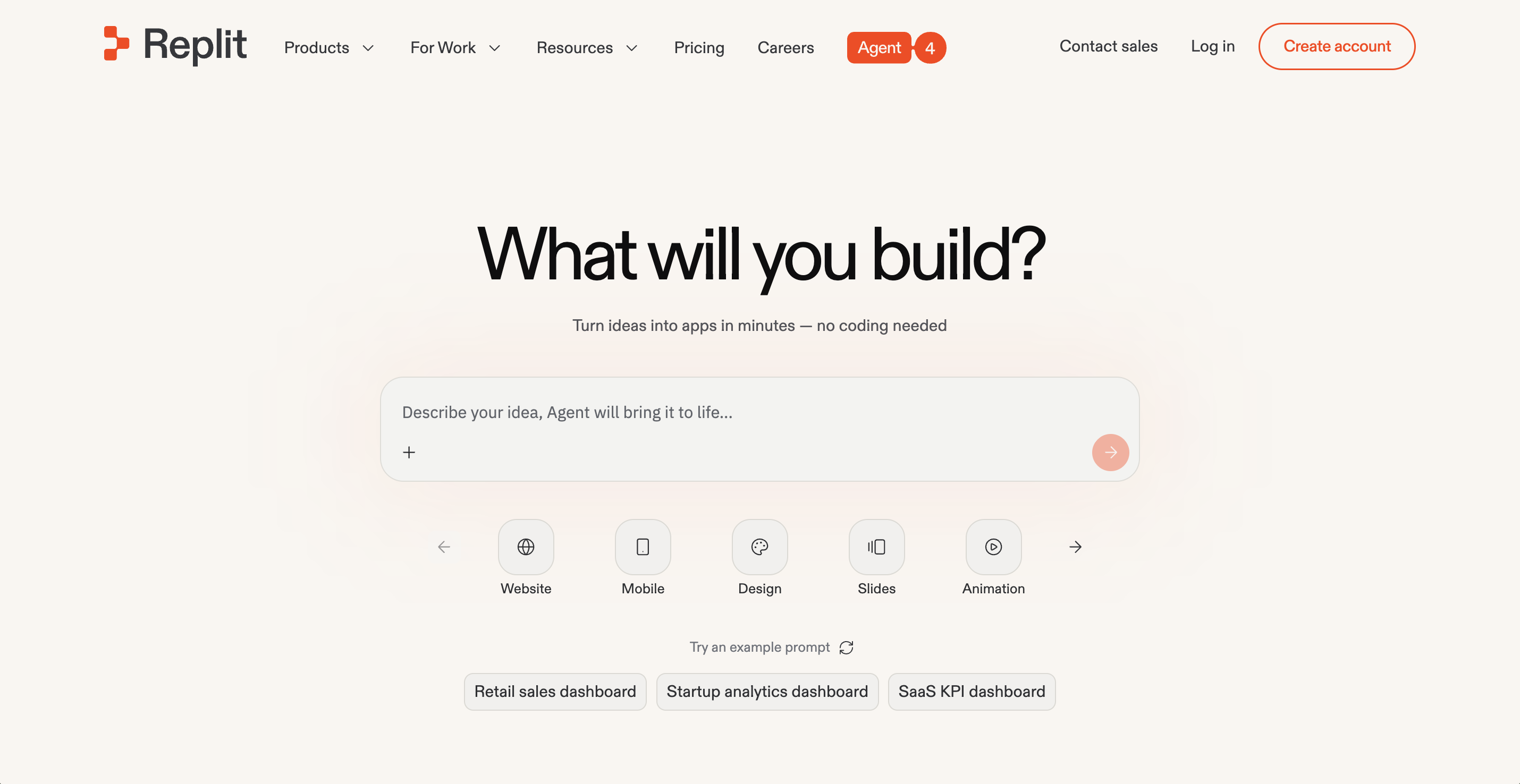
Replit delivers an end-to-end cloud development environment, which makes it the odd one out on this list. There is no desktop install at all. The workspace, database, hosting and deployment all live in the browser.
Agent 4 works autonomously, with built-in browser testing and self-fixing. Describe what you want and our Agent plans the build, writes the code, tests it in a real browser and publishes the result.
What comes out is ready to use: full web apps, internal tools and dashboards, data pipelines, automations, even slide decks. The public gallery shows what people actually ship.
Enterprise teams get a partnership with Microsoft Azure for deployment on Azure infrastructure, SOC 2 Type 2 compliance, and SAML SSO with single-tenant environments on the Enterprise plan. At Rokt, more than 700 employees built 135 internal apps in a 24-hour hackathon.
Replit pricing is built on effort-based pricing, so simple tasks cost less. Starter is free. Paid plans start at $20/month.
Pros:
- Ready-to-go output, from full web apps and dashboards to internal tools and slide decks
- Agent 4 plans, builds, tests and publishes from a single prompt
- Zero setup, with hosting and a database already in the workspace
Cons:
- A browser-first workflow takes adjustment for developers used to desktop IDEs
- Ambitious agent builds draw more credits under effort-based pricing
Bottom line: Replit is the only entry that replaces the environment around the editor instead of the editor itself. The payoff is a working, deployed product. Starter is free, so testing whether that browser-first trade suits you takes an afternoon.
2. Cursor
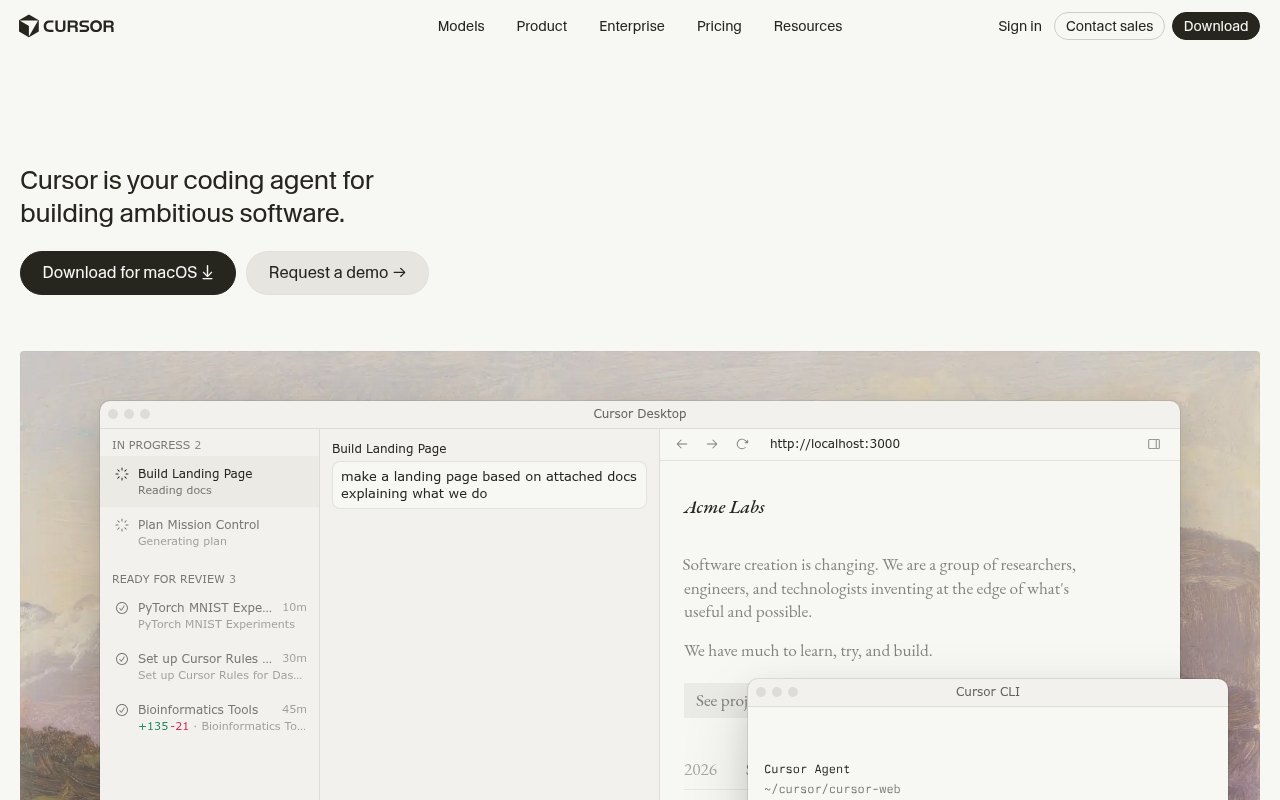
The most direct swap is Cursor, the AI-first fork of VS Code that Windsurf competed with head-on for most of its life.
Cursor builds on VS Code with Agent mode for autonomous multi-step tasks and access to frontier AI models. Its Composer model is tuned for fast agentic edits. Cloud agents run tasks away from your machine, and Bugbot reviews the code they produce.
The VS Code base means extensions, keybindings and themes move over intact. Transparent inline diffs keep each change visible, so you review what the agent did before any of it lands.
MCP servers, skills and hooks let you wire in your own tooling. The free Hobby plan covers evaluation. Pro starts at $20/month.
Pros:
- Closest like-for-like replacement for an agent-first desktop IDE
- Frontier model access, with Composer tuned for fast agent edits
- Full VS Code compatibility, so your setup carries over
Cons:
- Heavy agent sessions can exhaust included usage, then billing turns usage-based
- No self-hosted deployment for strict data environments
- Plan structures have changed several times, so budgets need rechecking
Bottom line: Cursor now leads the agent-IDE category Windsurf helped define, and it has been absorbing smaller rivals along the way. It rewards developers who live in the editor and want the deepest agent stack there. Keep an eye on usage if your agents run long.
3. GitHub Copilot
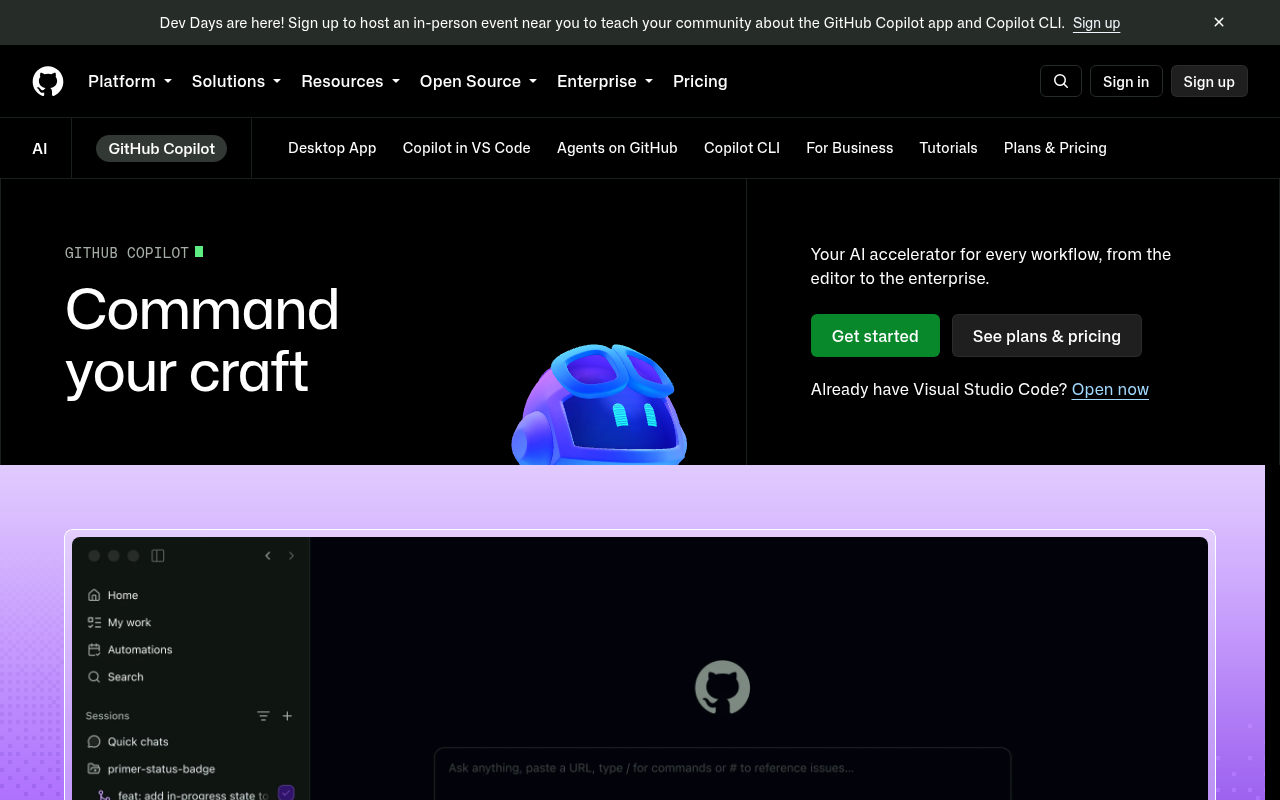
Wide IDE support is still GitHub Copilot's calling card. It works in VS Code, JetBrains IDEs, Neovim and Visual Studio, with deep GitHub integration everywhere.
Real-time completion, chat and multi-model support form the base layer. Paid plans add a cloud coding agent, AI code review and third-party agents such as Claude Code and Codex. Hand the agent an issue and it comes back with a pull request.
Because GitHub builds it, context from your repositories, issues and pull requests feeds every suggestion.
The free tier includes 2,000 completions and 50 chat requests per month, plus the Copilot CLI. Pro is $10/month, with AI credits metering the newer agent features.
Pros:
- Works in the editors most teams already use
- Free tier is enough for a real evaluation
- Model selection spans Anthropic, OpenAI and Google models
Cons:
- Agent features draw down monthly AI credits, so heavy use costs extra
- Strongest inside GitHub-centric workflows and less compelling outside them
- No self-hosted or air-gapped deployment option
Bottom line: Copilot has grown from plain autocomplete into the most complete mainstream assistant. Its moat is repository context. No rival reads your GitHub history as natively, which makes it the safe pick when your code already lives there.
4. Cline
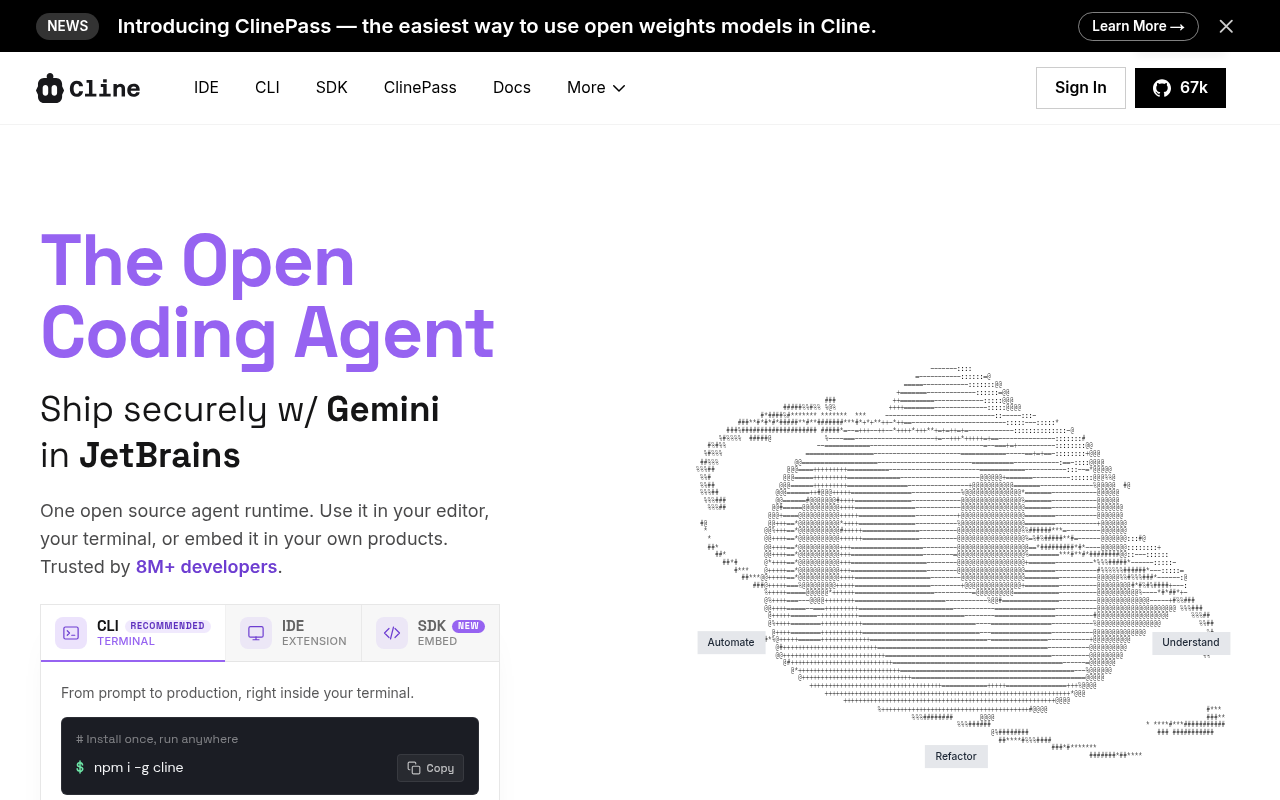
Cline is the control pick. The open-source agent runs in VS Code, in JetBrains IDEs in early access, and straight from the terminal, and it counts more than 8 million installs under an Apache 2.0 license.
Plan and Act modes split strategy from execution. You approve each step yourself, or switch on auto-approval once the agent has earned some trust.
Bring your own API keys for Anthropic, OpenAI, Google, OpenRouter or local models through Ollama, and pay only for the model usage itself. MCP support connects databases, APIs and internal tools, and rules files teach it your coding standards.
It also reaches beyond the editor, chatting through Slack, Linear and Discord and running headlessly in CI pipelines.
Pros:
- Free and open source, with no subscription required
- Total model flexibility, including fully local setups
- Plan and Act modes keep agent changes reviewable
Cons:
- Costs are only as predictable as your API usage
- Takes more initial configuration than subscription tools
- Output quality depends on the models you bring
Bottom line: Cline offers the most visibility of any tool here, from plan to API bill. That openness explains why the install base keeps growing even as rival tools get bought and shut down. Budget some setup time before it feels effortless.
5. Aider
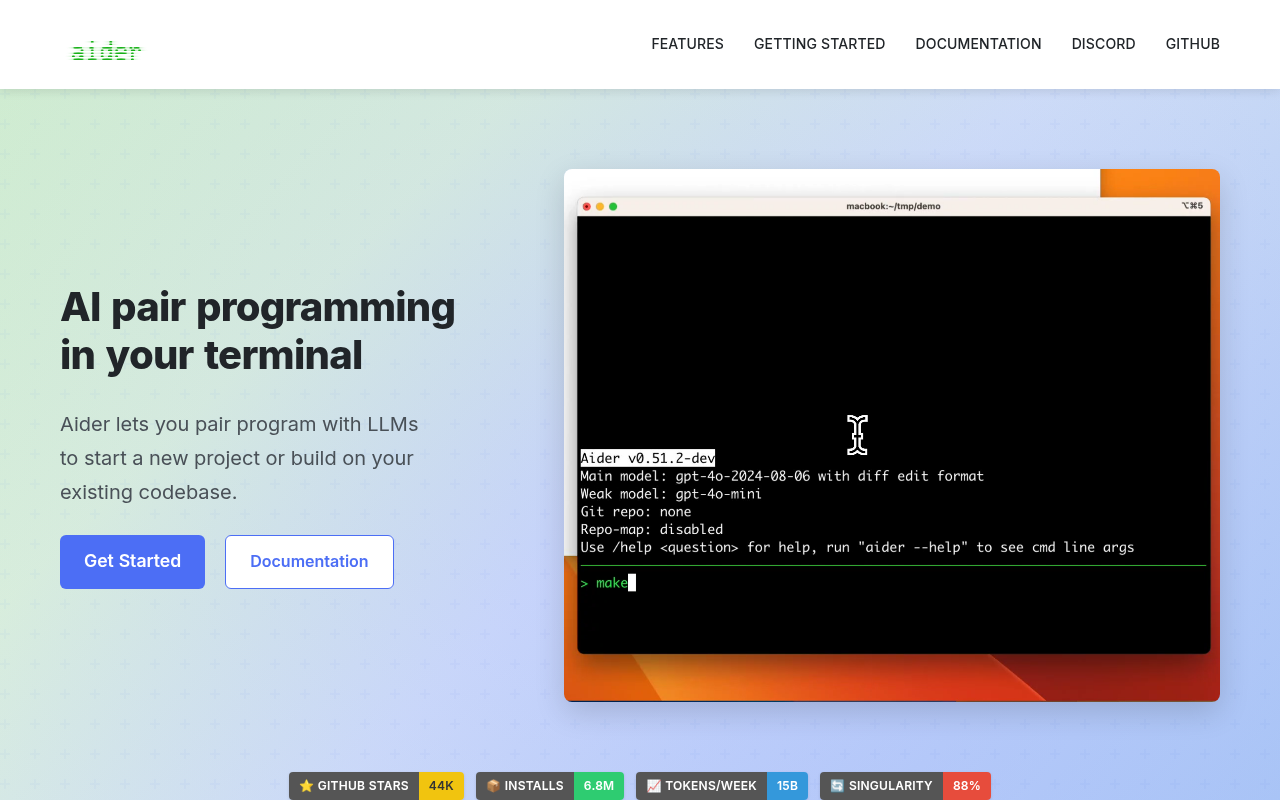
Terminal loyalists keep choosing Aider, and the numbers back them up: 44,000 GitHub stars and 6.8 million installs on PyPI.
You point it at a Git repository and describe changes in plain language. A repo map keeps it accurate as projects grow. Every edit lands as a Git commit with a sensible message, easy to review or undo with normal Git tools.
After each change it lints, tests and fixes what breaks. Voice input works, and screenshots or web pages can join the chat as context.
It is open source with no charge for the tool itself, and it connects to cloud or local models with your own keys, across more than 100 programming languages. The only cost is the model usage you pay your provider.
Pros:
- Automatic Git commits make every change reviewable and reversible
- Codebase map keeps it effective on larger projects
- Works with cloud or fully local models
Cons:
- A terminal workflow will not suit IDE-first developers
- Bring-your-own-key setup takes effort up front
- No review interface beyond the diffs Git already provides
Bottom line: Aider was proving terminal-first AI coding before most of this list existed. Git-native commits give automated editing an audit trail. Best for Git-fluent developers who want precision without paying for another subscription.
6. Zed
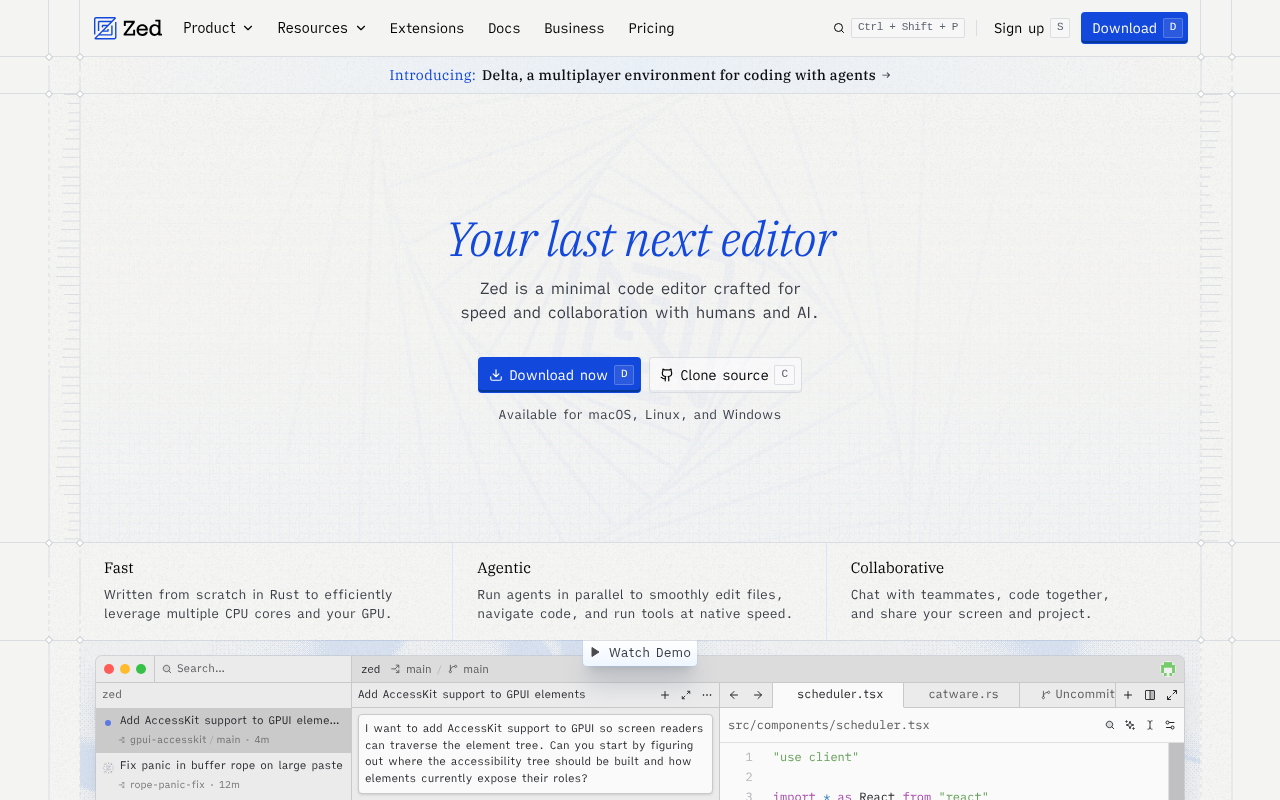
Raw speed sets Zed apart. The editor is written in Rust and rendered on the GPU, so it stays responsive where heavier editors stutter.
Multiplayer collaboration is native, and weekly releases keep improvements landing. The whole editor is open source. You can read it, patch it, or switch the AI off entirely and keep a fast editor.
For AI, Zed connects to the major model providers and to external agents such as Claude Agent and Codex CLI. It runs on macOS, Linux and Windows.
The free Personal plan includes 2,000 accepted edit predictions and unlimited use with your own API keys. Pro runs $10/month with $5 of tokens included.
Pros:
- Exceptional performance from a fully open-source codebase
- Free plan supports your own keys and external agents
- Native multiplayer goes further than VS Code's built-ins
Cons:
- Extension ecosystem is still younger than VS Code's
- SSO and SAML are planned but not available yet
- Hosted AI beyond included credits bills at API list price plus 10 percent
Bottom line: Zed is the strongest pure editor on this list. The AI layer stays optional by design, which suits developers who want speed first and agents second. Teams that require SSO should wait.
Two former entries are gone, and both ended up with the same owner. Cursor acquired Supermaven in 2024 and sunset it in 2025, folding its fast-completion technology into Cursor Tab. Supermaven's farewell note points remaining users to Cursor.
Continue met a similar end. Cursor acquired it in 2026 and wound down the hosted product, though the open-source code remains available. Cline above covers that open-source, model-agnostic ground and more.
7. Qodo
Qodo has narrowed its focus since this article first ran. The platform now centers on agentic code review, checking pull requests against your team's rules across GitHub, GitLab, Bitbucket and Azure DevOps.
Reviews draw from a pooled credit system, and smaller pull requests use fewer credits. A rules engine encodes your standards. Pre-PR skills catch issues before review even starts.
Pricing changed as well. The old free individual tier is gone, replaced by a 14-day trial, though qualified open-source projects can apply for free access. Pro Team starts at $30/month for up to 30 users.
Enterprise plans add SSO, audit logs, bring-your-own-key model control and on-premises or air-gapped deployment.
Pros:
- Agentic PR review with an unlimited rules system
- Deployment options up to on-premises and air-gapped
- Free program for qualified open-source projects
Cons:
- No permanent free tier anymore
- Focused on review, so you still need a separate tool that writes code
- Credit consumption varies with pull request size
Bottom line: Qodo answers a different question from everything else here: whether the code your tools produce holds up. That check matters more as agents write more of the code. Treat it as a quality gate, and pair it with one of the generation tools above.
8. Bolt.new
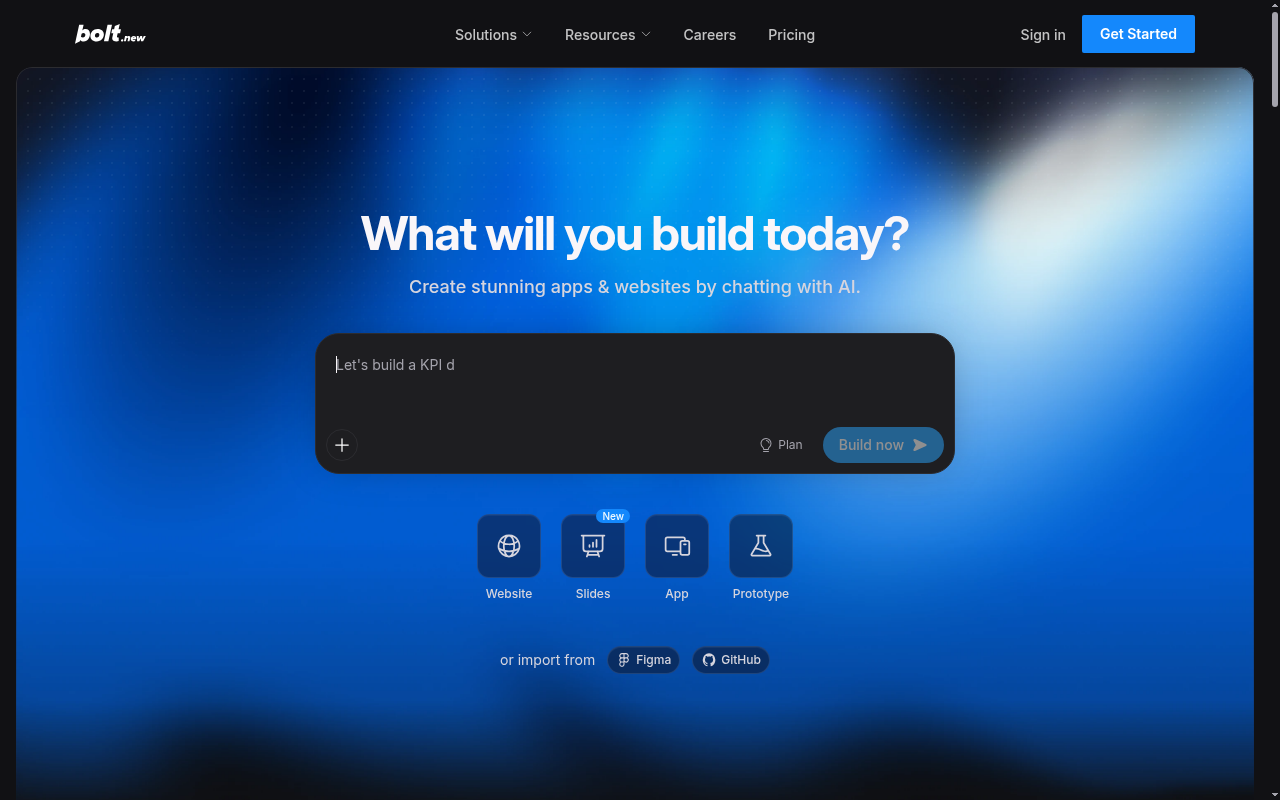
A prompt into Bolt.new comes back as a running full-stack app, with the preview sitting right beside the code.
StackBlitz builds it on WebContainers, so everything runs inside the browser tab. Hosting, unlimited databases and custom domains come included, and that carries a prototype further than you might expect.
The free plan includes 1 million tokens per month with a 300,000-token daily cap. Pro is $25/month, lifts the daily cap, and lets any unused tokens roll over into the following month.
Teams plans add shared workspaces and design-system awareness for organizations.
Pros:
- Fastest path on this list from prompt to visible prototype
- Hosting, databases and custom domains come built in
- Free plan is enough to test a real idea
Cons:
- Token use grows with project size, so larger apps burn budget faster
- The browser runtime suits web apps better than heavy back-end services
- Free-plan sites carry Bolt branding
Bottom line: Bolt.new owns the demo moment, when an idea needs to be clickable by this afternoon. Production hardening is the harder question. Larger builds will stress the token model, but for validation sprints it is hard to beat.
Choosing the right alternative
The quickest way to choose is to start from how you want to work.
| Use case | Recommended tools | Notes |
|---|---|---|
| Keeping your current editor | GitHub Copilot, Cursor | Copilot drops in with least friction, Cursor swaps the IDE |
| Keeping costs low | Aider, Zed | You pay only model calls or your own API keys |
| Control over models and code | Cline | Any provider's key or local model, Apache 2.0 license |
| Validating an idea | Bolt.new | Fastest path to a running, hosted prototype |
| Enterprise security | Replit, Qodo | SOC 2 Type 2, SAML SSO and agentic code review |
| Shipping a working product | Replit | Agent builds and publishes from a browser workspace |
You want to keep the editor you already use: GitHub Copilot drops into VS Code, JetBrains IDEs, Neovim and Visual Studio with the least friction. If you want another agent-first IDE instead, Cursor is the natural swap.
Cost is the constraint: Aider is open source and costs nothing itself, so you pay only for model calls. Zed plays a similar role, since its Personal plan stays free when you bring your own API keys.
Control over models, spend and the code itself comes first: Cline runs on any provider's key or a local model, under an Apache 2.0 license you can read. Expect some configuration before it feels smooth.
You are validating an idea instead of maintaining a codebase: Bolt.new turns the prompt into a running, hosted prototype faster than anything else on this list. Just watch token use as the project grows.
Enterprise security sets the pace: Replit leads here, with SOC 2 Type 2 compliance, SAML SSO and Azure deployment through the Microsoft partnership. Qodo adds agentic code review on top, with audit logs and on-premises options.
The point is to ship a working product: Replit takes your description, then our Agent builds the app and publishes it from a browser workspace with the database and hosting already inside. Start free and see how far one prompt goes.
Making your choice
The best Windsurf alternative depends on your specific needs. Try a few options during trial periods to find what fits your workflow best. If you want to skip local setup entirely and go from a natural language prompt to a deployed, full-stack app, start with Replit.
Frequently asked questions
What is the best Windsurf alternative?
It depends on how you work. Cursor is the closest fit if you want to stay in a desktop IDE built around agents, GitHub Copilot adds AI to the editors you already use, and Replit replaces the whole environment so you can build and deploy from one browser workspace.
Is there a free Windsurf alternative?
Yes. Cline and Aider are free and open source, so you pay only for AI model usage. GitHub Copilot, Zed, Bolt.new and Replit all offer free plans, which makes it easy to trial several options before you commit to a subscription.
What happened to Windsurf?
Cognition, the company behind the Devin coding agent, acquired Windsurf and renamed it Devin Desktop in 2026. windsurf.com now resolves to devin.ai, and existing plans, extensions and settings carry over automatically. The editor itself continues to be developed and supported under the new name.
Can I use a Windsurf alternative without switching editors?
Yes. GitHub Copilot works inside VS Code, JetBrains IDEs, Neovim and Visual Studio, and Cline runs as an open-source extension in VS Code or from the terminal. Both bring agentic AI to the setup you already have without changing where you work.